Our Mission

See Services, . We are on a Mission

Serve the Poor

To serve the poor and displaced children by providing programmes that help save lives, bring hope, restore dignity and raise their physical and educational levels in a meaningful, lasting way.

Relief

To serve the poor and displaced children by providing programmes that help save lives, bring hope, restore dignity and raise their physical and educational levels in a meaningful, lasting way.

Education

To serve the poor and displaced children by providing programmes that help save lives, bring hope, restore dignity and raise their physical and educational levels in a meaningful, lasting way.

Relieve Sickness

To serve the poor and displaced children by providing programmes that help save lives, bring hope, restore dignity and raise their physical and educational levels in a meaningful, lasting way.

Safeguard

To serve the poor and displaced children by providing programmes that help save lives, bring hope, restore dignity and raise their physical and educational levels in a meaningful, lasting way.

Become A Volunteer

If you have a particular skill, we may be able to use your talent. Perhaps you can help pen grant letters, make calls to potential donors or serve on the committee.

How We Help . In Several Ways

Prevention of child abuse

In the recent past it has been reported by various media that the incidents of child abuse is increasing at an alarming rate in developing countries. One of the main reasons identified as root causes for this social problem are single parent families, (social fragmentation due to mothers going to Middle East countries as migrant workers), poverty, lack of basic sex education in school children and change in behavioural patterns of society. It has been also identified that in addition to physical abuse of children that “Child Marriages” are also taking place in among some fragments of the society. In one case it was reported that a girl who was only 14 years of age, was “given away” by her parents to be married to a man of 40 years where she was raped and subsequently thrown to streets by this elderly man. She was subsequently found by police and handed over to the hospital. Even tough “Child Marriage” is strictly prohibited by law in most of the developing countries, it continues. HELP A POOR CHILD has been organising programmes with support of the local councils on a cost sharing basis increating awareness on “Prevention of Child Abuse” highlighting the social stigma attached to such incidents.Our initial program are targeted on hotspots reported by media, with the following:
Help where it can make a difference

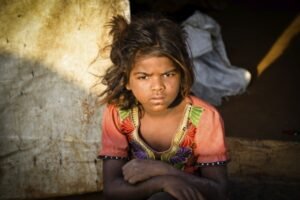
Although HELP A POOR CHILD has its clearly defined projects, it sizes on opportunities where it can make a difference.  Examples of such help have been the regular Book Distribution programmes to large groups of children representing multi-ethnic communities enabling some poor children show an interest in education and for others to resume their studies, which they had abandoned. Other examples have included HELP A POOR CHILD identifying children with severe disabilities and purchasing for them wheel chairs, which has made a huge difference in their lives.  A life without independent mobility means that disabled children essentially miss out on their childhood and it diminishes their life chances, adding to the terrible conditions in which they already live. HELP A POOR CHILD has also been involved in one off projects of varying types, but of having the same objective of making a difference. The renovating of toilets at a school of 900 poor children was a welcome experience for them, particularly the girls and teachers who had been using toilets, which were in an appalling and dilapidated condition.  The repair work had been overdue by several years.   As a result of the poor sanitary conditions, the children’s health were exposed to risks of infections and illness.  This project has already seen the instant benefit to the children from the complete renovating of the toilets. A Boarding Hostel housing 125 poor tribal boys had to be rebuilt following severe damage caused by floods. The Building has three “Halls” for Junior, Intermediate and Senior boys and are used by them to study and sleep.  HELP A POOR CHILD helped with the construction of one of the Halls, enabling the Hostel to resume its programme of helping the poor tribal boys.

HELP A POOR CHILD – 40th Anniversary

HELP A POOR CHILD – 40th Anniversary It all began in Bombay, India in March 1980 when an Indian nun, the late Mother Colombiere, Headmistress of St. Anne’s High School, challenged India to do something for the poor. In the UK, the first fundraising event was not held until 25 July of that year at the Wheatsheaf Pub, Tooting Bec, South London, which had a maximum capacity of 150. Tickets were priced at £1 and were all sold, with the “disco” taking place on the first-floor pub hall. At the time, the exchange rate was approximately Rupees 15 to £1, and a bank draft for £150, sent to Mother Colombiere, was exchanged for Rupees 2,250. These funds were used to feed some poor children in the slums and provide them with a bag containing clothes, books, and soap. Little did we know that this small fundraising event at the Wheatsheaf Pub would lead the charity to helping poor children in different parts of Asia and Africa for 40 years. 1980 – 2011 – From Bombay (Mumbai), Goa, Calcutta (Kolkata), and Madras (Chennai) in India to Kenya, Sri Lanka – embarking on a variety of programmes to help poor children.  Some included: 2012 – Present – HELP A POOR CHILD Gambia The charity’s flagship project – constructed in early 2012, our Colombiere School, currently has 193 children enrolled, with a teaching staff of eleven. To our donors, supporters, well-wishers, volunteers, patrons, board of trustees and management teams THANK YOU! None of our achievements would havebeen possible without yourhelp, generosity and kindness

Children continue with their studies, in spite of lockdown

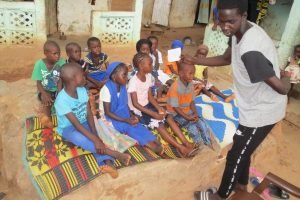
Children continue with their studies, in spite of lockdown Studies continue through radio learning. Of course, it was always going to be a challenge, to continue educating the Colombiere School children with the government’s enforced lockdown as a result of the COVID-19 virus. Unlike the west, where the internet is freely available and has helped with remote online teaching, in The Gambia, a lot of families have had to rely on radio learning.  This is where, during the lockdown, the national curriculum is taught through radio transmission as most of the families living in villages, only have a radio to keep in touch the everyday news, etc. Our Colombiere School was fortunate because a majority of the children who attend the school, live in the nearby village and in close proximity to one another.  So, in addition to lessons being taught via the radio, some of the school teachers, went to the villages, to formally conduct the daily lessons. This was a huge effort by the staff in very difficult circumstances, ensuring the school classes continued in spite of the restrictions imposed.